Getting Better Survey Responses: Practical Tips
Are you struggling to get people to complete your online surveys? You're not alone. Whether you're gathering customer feedback, conducting market research, or collecting employee insights, getting good response rates can feel like an uphill battle. The good news? Recent research shows that well-designed online surveys can achieve response rates of over 40% (Wu et al., 2022). Let's explore practical strategies that can help you get there.
What Makes People Complete Surveys?
Before diving into specific tactics, it's helpful to understand what motivates people to respond. Recent studies have shown that trust, personalization, and clear design are key drivers of participation (Brosnan et al., 2019). Research indicates that people are more likely to respond when:
They trust the organization sending the survey
The survey feels relevant to them
It's easy to complete
They understand how their input will be used
They feel their time is respected
Let's look at how you can put these insights into action.
Make Your Survey Quick and Simple
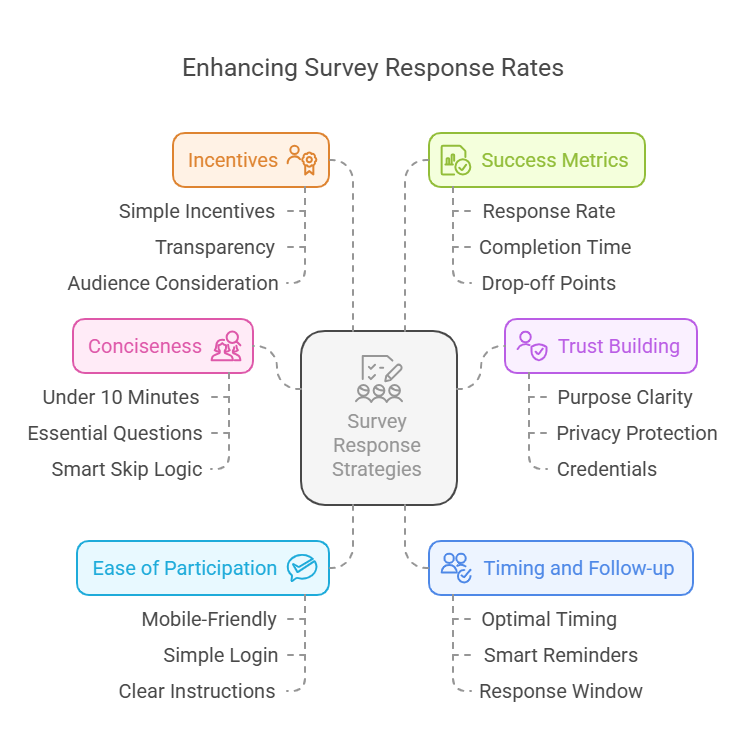
The number one reason people abandon surveys? They're too long. Research has consistently shown that surveys taking no longer than 10 minutes to complete achieve higher response rates (Sammut et al., 2021). Here's how to keep things concise:
Keep It Under 10 Minutes: Research shows that survey completion rates drop significantly after 10 minutes (Sammut et al., 2021). Time yourself taking the survey - if it's longer than 10 minutes, it's time to trim.
Focus on Essential Questions: Before adding a question, ask yourself: "What will we do with this information?" If you don't have a clear answer, leave it out.
Use Smart Skip Logic: Modern survey tools let you customize the question flow based on previous answers. This kind of smart routing makes surveys feel more personal and relevant to each respondent (Brosnan et al., 2019). For example, if someone indicates they've never used your product, they automatically skip product-specific questions and move to more relevant sections. This not only saves time but shows respondents you value their time by only asking applicable questions.
Build Trust From the First Contact
People are more likely to respond when they trust you. Building trust through transparent communication has been shown to be fundamental to encouraging completion (Brosnan et al., 2019). Here's how to establish that trust:
Be Clear About Purpose: Tell people exactly why you're conducting the survey and how you'll use their responses. Research shows that understanding the survey's purpose strongly influences participation (Brosnan et al., 2019).
Protect Privacy: Clearly explain how you'll handle their data. If responses are anonymous, say so - studies indicate this can significantly boost response rates.
Show Your Credentials: Use your official email address and branding. Research has shown that organizational credibility plays a key role in survey response (Holtom et al., 2022).
Make It Easy to Participate
The easier you make it for people to respond, the more likely they are to complete your survey. Studies have shown that optimizing the respondent experience directly correlates with improved participation (Sammut et al., 2021):
Mobile-Friendly Design: More than half of survey responses now come from mobile devices. Test your survey on different devices before sending it out.
Simple Login Process: If you need respondents to log in, make it as straightforward as possible. Research shows that implementing a semi-automatic login system improves response rates (Sammut et al., 2021).
Clear Instructions: Use simple language and provide examples where needed. Avoid technical jargon unless you're sure your audience understands it.
Perfect Your Timing and Follow-up
When and how you send your survey matters just as much as what's in it. Research has shown that pre-contacting potential participants and using strategic reminders can positively influence response rates :
Choose the Right Time: Recent research from SurveyMonkey, Zendesk and CheckMarket suggest that Monday through Thursday are the best days to send online surveys, with early morning (4-6 AM) and mid-morning to early afternoon (9 AM-12 PM) yielding the highest response rates. Targeting low-peak times like early mornings, lunchtime, late afternoons, or post-work evenings (after 6 PM) is generally recommended. However, optimal timing can vary based on the study, target audience, and survey type. Consider these factors and test different timings for your specific audience to maximize responses through a data-driven approach.
Send Smart Reminders: Two follow-up reminders is the optimal number according to research (Sammut et al., 2021). More than that can annoy people. Space them out appropriately - perhaps one after 3 days and another after a week.
Give a Reasonable Window: Allow 7-10 days for responses. This gives people enough time without letting the survey lose urgency.
Should You Offer Incentives?
The research on incentives presents mixed findings. While some studies show that lottery-based incentives can enhance participation (Sammut et al., 2021), others find limited impact (Wu et al., 2022). If you decide to use incentives:
Keep Them Simple: Small gift cards or discount codes often work better than complex reward schemes.
Be Transparent: Clearly explain how and when participants will receive the incentive.
Consider Your Audience: What might be valuable to one group could be meaningless to another. Know your audience.
Measuring Success
How do you know if your survey strategy is working? Recent research by Holtom et al. (2022) suggests tracking these key metrics:
Response Rate: What percentage of people are completing your survey?
Industry average is around 44.1% for well-designed surveys
Track this over time to see if your changes are working
Completion Time: Are people taking roughly as long as you estimated to complete the survey?
Drop-off Points: Where are people abandoning the survey? This can help you identify problem areas.
Quick Implementation Checklist
Survey Design:
Kept under 10 minutes
Mobile-friendly format
Clear, simple questions
Logical flow
Communication:
Clear purpose statement
Professional branding
Privacy assurances
Contact information
Follow-up Plan:
Initial invitation
Two reminder messages
Thank you note
Conclusion
Getting good survey responses isn't about fancy techniques or complex strategies. It's about respecting your respondents' time, making participation easy, and being clear about how their input matters. Start with these practical steps, measure your results, and adjust as needed.
Remember: Every audience is different. Pay attention to what works with your specific group and be willing to adapt your approach based on their preferences and behaviors.
References
Brosnan, K., Kemperman, A., & Dolnicar, S. (2019). Maximizing participation from online survey panel members. International Journal of Market Research, MRE0010.1177/1470785319880704.
Holtom, B., Baruch, Y., Aguinis, H., & Ballinger, G. A. (2022). Survey response rates: Trends and a validity assessment framework. Human Relations, 75(8), 1560-1584.
Sammut, R., Griscti, O., & Norman, I. J. (2021). Strategies to improve response rates to web surveys: A literature review. International Journal of Nursing Studies, 123, 104058.
Wu, M.-J., Zhao, K., & Fils-Aime, F. (2022). Response rates of online surveys in published research: A meta-analysis. Computers in Human Behavior Reports, 7, 100206.
