Online Survey Research: Importance and Practical Tips to Consider
Online surveys have revolutionized the way researchers collect data, making it faster, more cost-effective, and accessible to a broader audience. Whether for market research, academic studies, or social analysis, online surveys offer a structured approach to gathering and analyzing data. This blog post explores the significance of online survey research and provides detailed practical tips with examples to ensure its success.
Why Online Survey Research Matters
1. Informed Decision-Making
Online surveys help businesses, policymakers, and researchers make data-driven decisions by understanding customer preferences, employee satisfaction, market trends, and public opinions. For example, an e-commerce company may use an online survey to assess customer satisfaction and identify areas for improvement.
2. Cost-Effective Data Collection
Compared to traditional methods like face-to-face interviews or mail surveys, online surveys are significantly more affordable. Platforms such as Google Forms, SurveyMonkey, and Typeform allow researchers to create and distribute surveys at minimal or no cost. For instance, a small business can run an online survey through a free platform to gather customer feedback without investing in expensive research tools.
Scalability and Reach
Online surveys can be distributed to a large number of respondents globally without geographical constraints. This makes them ideal for businesses expanding internationally or researchers targeting diverse demographics. For example, a university conducting an alumni survey can reach graduates across different countries using an online platform.
4. Flexibility in Design and Data Collection
Online surveys provide flexibility in design, allowing the inclusion of multiple question types such as multiple-choice, Likert scales, and open-ended questions. Additionally, respondents can complete surveys at their convenience, improving participation rates. A fitness app, for instance, can use an online survey to gather user feedback about new workout features at any time.
Practical Tips for Conducting Effective Online Surveys
1. Define Clear Objectives
Before designing an online survey, it is essential to hold an initial meeting between the researcher and the client requesting the research. This meeting serves as a platform to discuss objectives, ensuring that both parties have a clear understanding of what the client needs and how the researcher can fulfill those requirements. Additionally, discussions on the timeline and cost of the project may also take place during this stage. The outcome of this meeting will later be reflected in the research proposal, ensuring mutual alignment and efficiency. Are you measuring customer satisfaction, identifying trends, or collecting demographic data? Clear objectives ensure the survey remains focused and relevant. For example, an online retailer may aim to understand why customers abandon shopping carts by conducting a targeted survey, or a financial brand wants to know how its brand lift has changed after running an advertising campaign.
Choose the Right Online Survey Platform
Whether you are a corporate client with a big budget to run research or a small business trying to understand your niche, the tools you need can be different. Big corporations often collaborate with expert marketing research firms such as Nielsen, Kantar, or Ipsos to conduct surveys. These companies leverage their own panels or access client email lists to reach a targeted audience efficiently. On the other hand, small businesses may opt for less expensive tools like Google Forms or SurveyMonkey, which allow them to conduct surveys independently at a lower cost. Several online survey tools offer different features, so selecting the right platform is crucial. Consider factors such as ease of use, customization options, and integration with other software. Popular platforms include:
Google Forms – Free and easy to use, suitable for basic surveys.
SurveyMonkey – Provides advanced analytics and customization.
Typeform – Offers an interactive and engaging survey experience.
Qualtrics – Ideal for academic and enterprise-level research.
For example, a startup seeking user feedback on a new product might choose Typeform for its visually appealing interface that encourages engagement
3. Craft Clear and Concise Questions
Use simple, unambiguous language to avoid confusion. For example, instead of asking 'Do you find our product to be satisfactory and reliable?' (which combines two ideas), use 'How satisfied are you with our product?' and 'How reliable do you find our product?' separately. This ensures clarity and prevents misinterpretation.
Avoid leading or biased questions to ensure objective responses. For example, an inappropriate question would be 'Don't you agree that our product is the best in the market?' because it assumes a positive response. A more appropriate way to phrase it would be 'How would you describe your experience with our product?' which allows respondents to form their own unbiased opinions.
To maintain respondent engagement, keep survey questions short and easy to understand. Long, complex questions increase cognitive load and may lead to fatigue or inaccurate responses. For example, instead of asking, “Based on your recent experience, to what extent do you agree that our customer service team effectively resolved your issue in a timely manner while demonstrating professionalism, clear communication, and a willingness to go above and beyond to ensure your satisfaction?”, a more effective version would be, “How satisfied are you with the support provided by our customer service team?” This concise approach improves clarity and response quality.
Use a mix of question types to collect both qualitative and quantitative data. For example, a tech company launching a new app feature might ask: On a scale of 1-10, how satisfied are you with the new feature? What improvements would you like to see? (Open-ended question)
4. Use a Logical Flow
Designing a well-structured questionnaire is crucial for collecting meaningful insights. One common mistake made by less experienced researchers is organizing survey questions in the same order as research objectives, which may not create a logical flow for respondents. To ensure clarity and effectiveness, the questionnaire should be structured in a way that encourages natural responses while avoiding biases.
When designing a questionnaire, several factors should be considered:
Organizing sections to align with specific research objectives.
Ensuring a logical question flow that enhances respondent comfort and engagement.
Avoiding questions that might lead to biased responses in subsequent sections.
Generally speaking, questions follow this sequence, but it may be changed to suit the needs of the study:
Screening quotas: Questions to establish that we are interviewing the appropriate participants. Examples:
TV Channel Viewership: How often do you watch ABC TV Channel? (Daily, Weekly, a few times a month, Rarely, Never [Terminate])
Ad Exposure: Have you seen an ad for Fashion Brand XYZ on ABC TV Channel in the past [timeframe]? (Yes, No, Not Sure)
Main section: This section includes both simple and complex questions designed to align with the study’s objectives. A useful structure is to follow the marketing funnel framework which tracks the customer journey from awareness to Advocacy. Questions can be framed in a chronological sequence to capture behavioral patterns, perceptions, and intent.
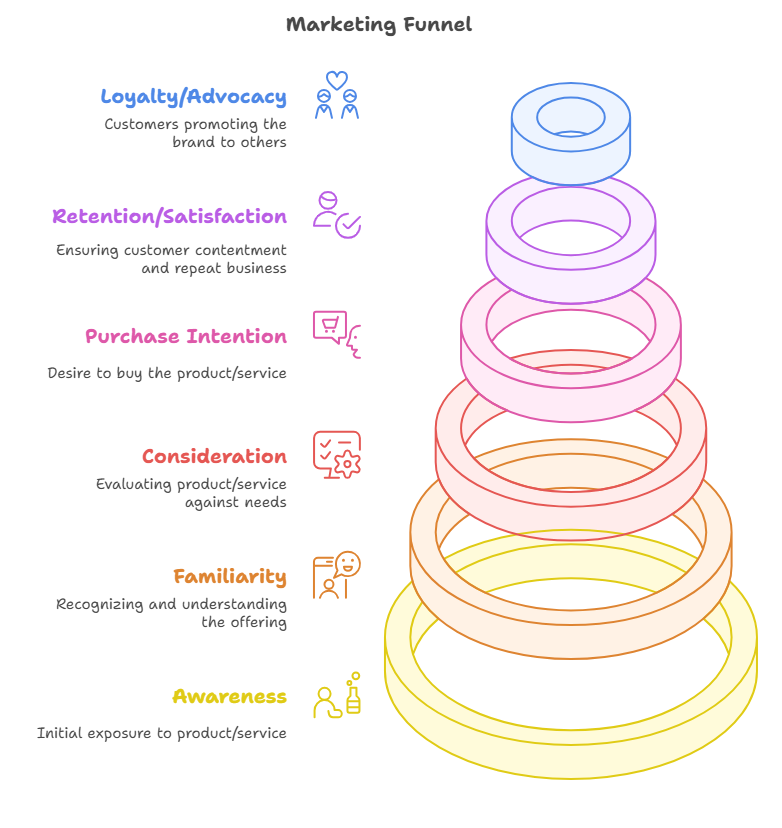
Marketing Funnel: A strategic framework that outlines the customer's journey through sequential stages—from initial product awareness to becoming a loyal advocate.
Behavioural questions: These assess respondents' past actions. Example:
With whom do you typically watch TV? (Alone, With family, With friends, With partner, Other)
Attitudinal questions: These capture opinions and beliefs. Example:
To what extent do you agree or disagree with the use of animal fur in clothing production?
Lifestyle questions: These focus on daily habits and routines. Example:
Do you usually browse fashion clothing websites or online stores before visiting a physical store to make a purchase?
Classification: These questions gather essential background information, such as:
What is the total annual income of your household before taxes during this past year?
What is the highest level of education you have completed?
When designing a survey, it is essential to structure questions in a way that maximizes respondent engagement and ensures logical flow. Start with general, easy-to-answer questions to make respondents comfortable and encourage participation. As the survey progresses, move to more specific or sensitive questions, allowing respondents to gradually ease into more complex topics. Finally, group similar topics together to maintain clarity and coherence, reducing confusion and enhancing the overall quality of responses. This strategic approach helps improve data accuracy and ensures a smoother survey experience.
6. Keep Surveys Short and Engaging
Long surveys can lead to respondent fatigue and lower completion rates. Ideally, online surveys should take no more than 10-15 minutes to complete. Use progress bars and clear section headings to keep respondents motivated. For instance, a fashion brand conducting a style preference survey can use a mix of images and short-answer questions to make the survey visually appealing.
7. Offer Incentives to Improve Response Rates
Providing incentives such as discounts, gift cards, or sweepstakes entries can significantly boost response rates. However, ensure that incentives do not bias the results. For example, a food delivery app could offer a discount on the next order for users who complete a satisfaction survey.
8. Pilot Test Before Launching
Testing the survey involves two key tasks: one performed by the researcher and the other by respondents while the researcher monitors the process. First, the researcher runs the survey multiple times through different paths to verify that all elements are in the correct order, ensuring logic flows properly and there are no skipped or redundant questions. Then, a small group of respondents completes the survey while the researcher observes their experience, helping to identify potential issues such as unclear questions, formatting errors, or technical glitches. For instance, testing the survey with 30 participants from the sample and reviewing their responses enables researchers to assess the organization and coherence of the survey before proceeding with a full launch.
9. Ensure Data Privacy and Confidentiality
Clearly communicate how respondent data will be used and obtain the necessary permissions for data collection. To protect privacy, anonymize responses whenever possible. For example, an HR department conducting an employee engagement survey should ensure confidentiality to encourage honest and candid feedback from employees.
10. Data Processing After Data Collection
Once data collection is complete, it is essential to process and clean the data before analysis. This step ensures accuracy, consistency, and reliability in survey responses. Researchers should:
Check for missing or inconsistent data and determine whether to impute or discard incomplete responses.
Standardize data formats for consistency.
Remove duplicate or fraudulent responses to maintain data integrity.
Categorize open-ended responses through coding for easier analysis.
Since analysts need clear and well-structured tables (e.g., cross-tabs dataset) to efficiently interpret and compare responses, it is important to provide these tables at this stage of data processing.
Store the processed data securely to ensure privacy compliance.
11. Analyze and Interpret Results Effectively
Effective data analysis involves not only collecting survey results but also presenting them in a clear and meaningful way. Using data visualization tools helps highlight key trends and insights, making complex information more accessible. By comparing survey data with historical trends or industry benchmarks, researchers can gain valuable context and identify patterns that may otherwise go unnoticed. These insights should then be translated into actionable recommendations to guide strategic decisions. For example, an online streaming service analyzing user preference survey results might use charts and graphs to detect emerging viewing trends and refine content recommendations to better align with audience interests.
Conclusion
Online survey research remains a vital method for collecting actionable insights, provided it is executed with precision. A successful survey begins with clear objectives and careful platform selection, ensuring that the right audience is reached. Thoughtfully designed questions, logical sequencing, and respondent engagement strategies further enhance the quality of responses. Moreover, data privacy, rigorous pre-launch testing, and meticulous data processing contribute to the survey’s credibility and accuracy. Ultimately, leveraging these best practices allows businesses and researchers to transform raw data into meaningful, data-driven decisions that lead to strategic success.
